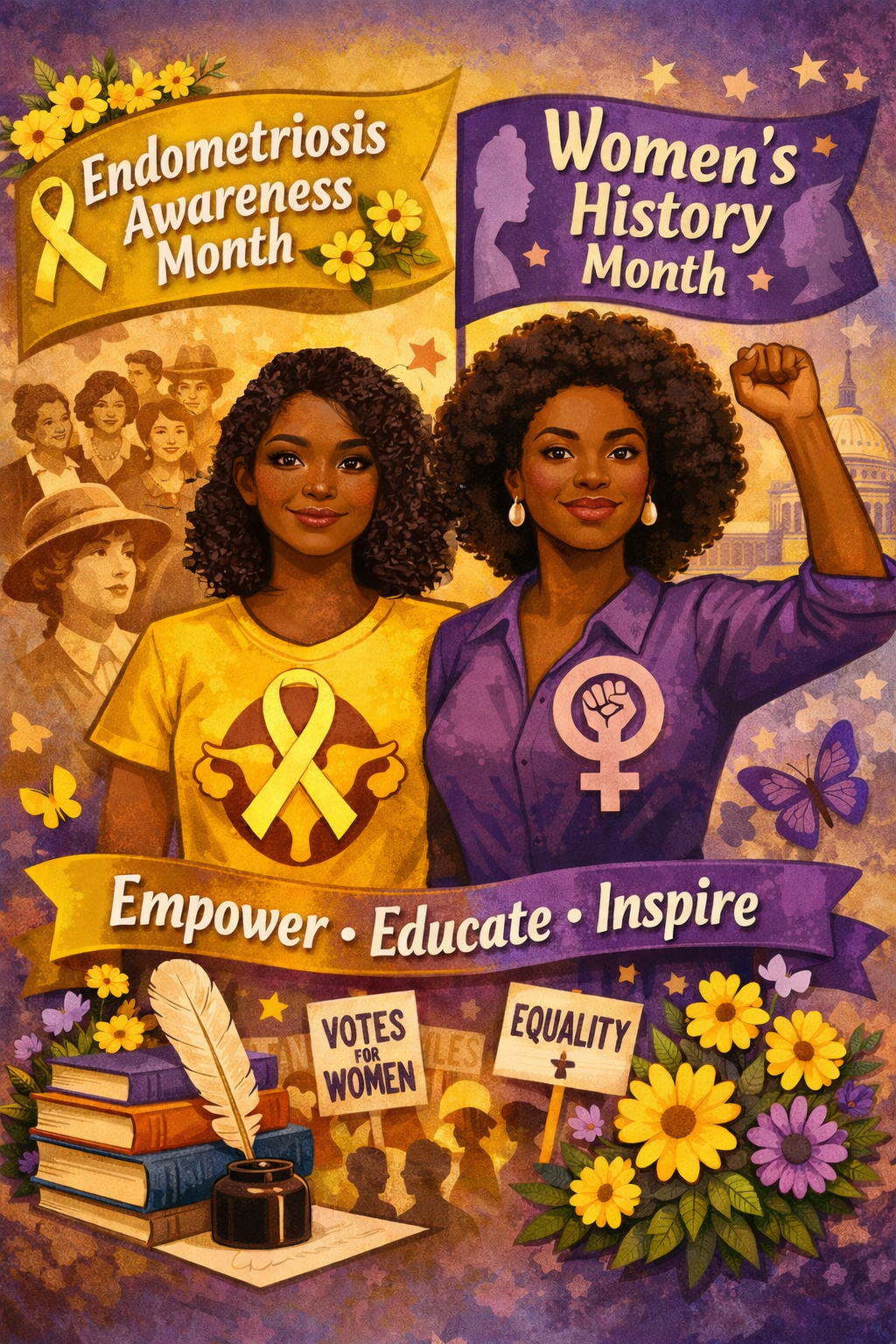
March always feels layered for me.
It is Women’s History Month a time to celebrate the brilliance, resilience, and contributions of women across generations. But it is also Endometriosis Awareness Month. And for me, that part is not abstract. It is personal. It is physical. It is 26 years long.
For 26 years, my body has been a battleground.
Ultrasounds.
Biopsies.
Surgeries.
Waiting rooms.
Cold exam tables.
Doctors who listened.
Doctors who didn’t.
Pain that stole entire days.
Fatigue that no amount of sleep could fix.
Smiles I forced so no one would ask too many questions.
I was 32 years old when I finally met a doctor who listened to me and diagnosed me with endometriosis.
Thirty-two.
Emotionally, it felt incredible to be believed. There is something powerful about having a medical professional finally say, “You’re not crazy. Your pain is real.” That validation mattered. It still matters.
But the sad truth is this: there is no cure for endometriosis.
There is management. There are temporary solutions. There are surgeries that may help. There are medications that may slow progression. But there is no cure.
For now, I settle for birth control while I wrestle with another deeply personal question motherhood. I am told my chances of pregnancy are low because of this condition. So I sit in that uncertainty. I sit with the possibility. I sit with the grief of what might not be. And I sit with the freedom of knowing I still get to choose what motherhood means for me.
The birth control, thankfully, has slowed the growth for me. I recognize that as privilege. This option is not always available to every woman who suffers. Some women have no options. Some live in constant, unmanaged pain. Some cannot tolerate the medications. Some are dismissed over and over again.
To those women you have my deepest empathy. My deepest respect. My deepest apology for a system that still has not prioritized answers.
I pray that one day we will find a cure.
I pray that research funding increases.
I pray that diagnosis comes faster.
I pray that no young girl has to wait until 32 to be believed.
I pray that no one has to silently carry this level of pain again.
Endometriosis is often described clinically—tissue similar to the lining of the uterus growing outside of it. But that definition does not capture what it feels like to live inside this body.
It doesn’t explain the isolation.
It doesn’t explain canceling plans again.
It doesn’t explain wondering if you’re “dramatic.”
It doesn’t explain learning to function in survival mode.
March is dedicated to raising awareness about this chronic, often debilitating and underdiagnosed condition affecting 1 in 10 women and individuals with a uterus about 190 million people worldwide. On average, it takes 7 to 10 years to receive a diagnosis.
Seven to ten years of being unheard.
Seven to ten years of doubting yourself.
Seven to ten years of surviving something you cannot yet name.
As a woman who has endured 26 years of this I carry both grief and pride.
Grief for the younger version of me.
Grief for the pain.
Grief for the uncertainty.
But pride because I am still here.
Because I built a life anyway.
Because I kept showing up.
Because pain did not get to define my worth.
During Women’s History Month, we celebrate women who changed the world. And we should. But I also want to honor the women quietly fighting inside their own bodies every single day.
The woman who goes to work in pain.
The woman navigating infertility in silence.
The woman exhausted but still giving.
The woman who feels unseen.
To every woman living with endometriosis: I send you love. I send you strength. I send you research energy. I send you validation. You are not weak. You are not dramatic. You are not alone.
Our stories matter.
Our pain is real.
Our endurance is extraordinary.
And perhaps this is why I do the work I do.
Because living inside pain teaches you how to recognize it in others.
Because fighting to be heard makes you listen more closely.
Because surviving something invisible makes you gentler with what others carry silently.
This month, I am honoring women including myself not just for what we accomplish, but for what we survive.
And that, too, is history.
💜💛Aline

 InspiredbyAline